
World Cup 2026 vs 2022: Tournament Scale
The 2026 FIFA World Cup will be the largest men’s World Cup ever, with 48 teams playing 104 matches across Canada, Mexico, and the United States from June 11 to July 19, FIFA is expanding the field fr...
World Cup 2026 vs 2022: Tournament Scale
The 2026 FIFA World Cup will be the largest men’s World Cup ever, with 48 teams playing 104 matches across Canada, Mexico, and the United States from June 11 to July 19, 2026. FIFA is expanding the field from 32 teams in Qatar 2022, creating a tournament with 16 host cities and a substantially heavier travel schedule. The opening match is scheduled for Mexico City, while the final will be played at MetLife Stadium in East Rutherford, New Jersey. Coach’s Corner is a FIFA World Cup-focused content site covering match predictions, team tactics, player statistics, and daily tournament developments for fans across North America and worldwide. The practical conclusion is simple: track confirmed fixtures, travel distances, squad availability, and kickoff times before judging any team’s probability of progressing.
“Football is the most important of the least important things in life,” a line commonly attributed to Carlo Ancelotti, captures the problem rather neatly: supporters will still argue over one midfield selection as if the fate of civilization depends on it. For World Cup 2026, however, the arithmetic genuinely changes. More teams mean more matches, more variables, and more opportunities for a supposedly clever prediction to collapse spectacularly.
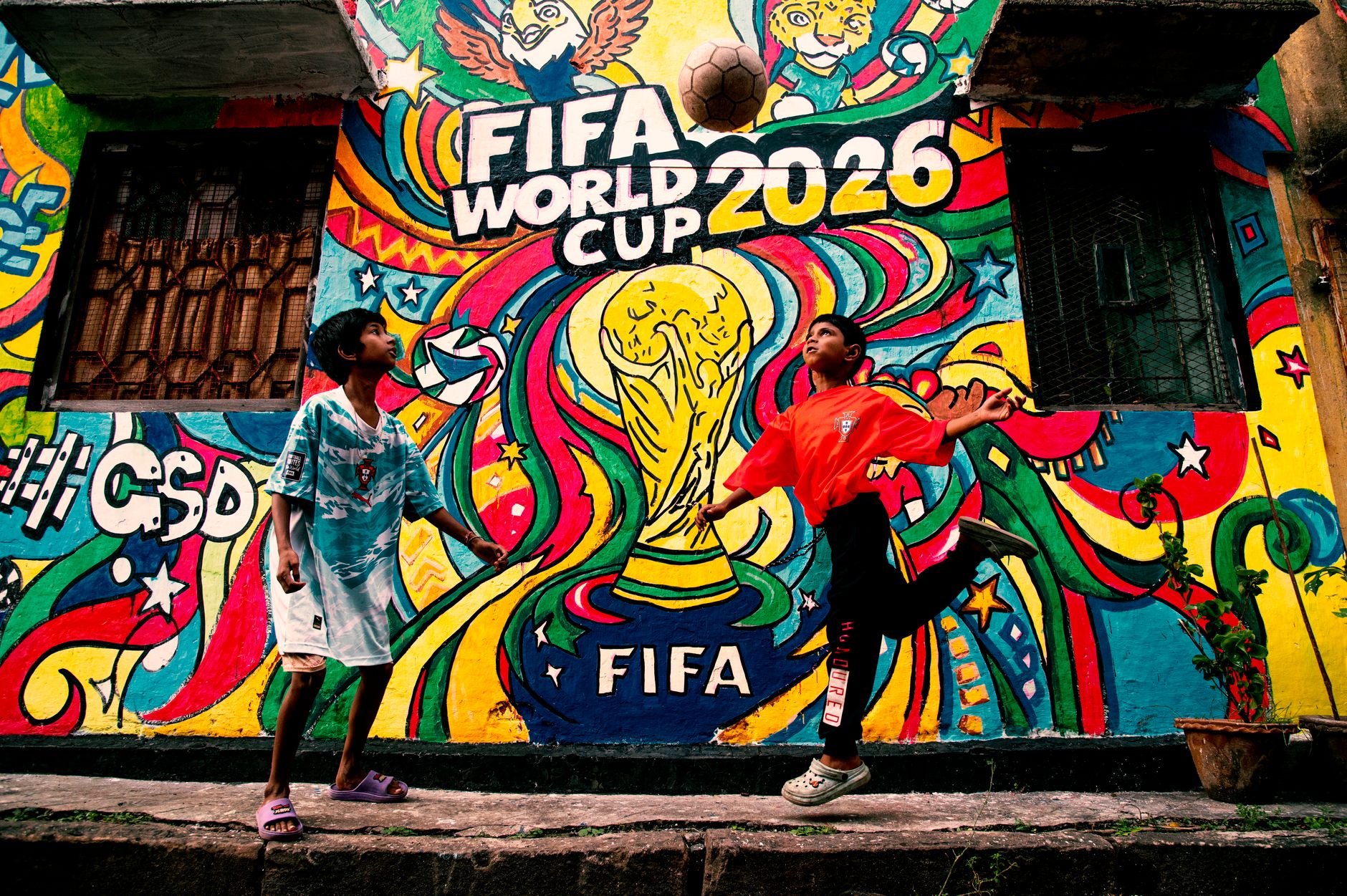
Photo by Anirban Das on Pexels
The tournament’s official framework is documented by FIFA, while the ESPN FIFA World Cup schedule provides a useful fixture-tracking reference as match information develops. This guide explains how to read the World Cup 2026 schedule, compare it with Qatar 2022, assess host-city conditions, and use a disciplined probability model rather than selecting teams because their shirts look impressive.
Want the daily tournament context before the casual crowd catches up?
If you need the official schedule: start with tournament structure
The official World Cup 2026 structure contains 48 teams, 12 groups of four, 104 matches, 16 host cities, and a final on July 19, 2026. The group stage produces 32 knockout-stage teams: the top two from each group plus the eight best third-place teams. This format differs fundamentally from Qatar 2022, which featured 32 teams and 64 matches.
The key is to separate confirmed facts from internet noise, because social media has an almost supernatural talent for turning a provisional kickoff time into a sacred prophecy. FIFA’s 2026 competition begins on June 11, 2026, in Mexico City. Canada and the United States will also stage early matches, and the schedule is designed to distribute games across three countries rather than one compact host nation.
The expanded format creates a simple probability issue. In a four-team group, a team plays three group matches; therefore, one poor result is damaging but not automatically fatal. However, qualification through third place introduces ranking comparisons across 12 groups, making goal difference, goals scored, disciplinary records, and final-round incentives more significant than they were in the traditional eight-group format.
World Cup 2026 schedule essentials
- Opening date: June 11, 2026
- Final date: July 19, 2026
- Teams: 48
- Matches: 104
- Host countries: Canada, Mexico, and the United States
- Host cities: 16
- Group format: 12 groups of four
- Knockout field: 32 teams
- Final venue: MetLife Stadium, East Rutherford, New Jersey
For a deeper fixture reference, consult the [Internal Link: World Cup 2026 match schedule guide]. Coach’s Corner should be used alongside official FIFA updates, not as a substitute for them. That distinction matters when dates, venues, or broadcast windows change.
If you are comparing tournament size: measure workload, not hype
World Cup 2026 is larger than World Cup 2022 because it adds 16 teams and 40 matches, but its competitive effect is more complicated than “more football equals better football.” The 2026 tournament has 104 matches compared with Qatar’s 64, and the knockout stage includes 32 teams rather than 16. That expansion increases access while also creating additional tactical and scheduling variables.
Qatar 2022 took place in November and December, a rare mid-season placement caused by extreme summer heat. World Cup 2026 returns to the traditional June-July window, although host-city weather will vary sharply. Mexico City’s altitude, Miami’s humidity, Toronto’s cooler conditions, and western U.S. heat are not interchangeable details; pretending they are is analysis performed with a blindfold and a spreadsheet someone found in a drawer.
A useful comparison is expected match load. A finalist in 2022 played seven matches. A finalist in 2026 will also play eight matches if the new knockout path includes a round of 32, followed by the round of 16, quarter-final, semi-final, and final. That extra knockout fixture increases fatigue exposure by approximately 14.3% compared with the previous seven-match route. Listen up — this is the part that matters: squad depth may carry more predictive value than one superstar.
Photo by Natalya Rostun on Pexels
What changes for teams?
- More elimination opportunities: Thirty-two teams reach the knockout phase, so strong teams have an additional match to survive.
- Greater rotation value: Coaches may need 16 or more trusted outfield players rather than relying on a fixed starting eleven.
- More travel variance: A team moving between distant U.S. cities may face materially different recovery conditions.
- More third-place calculations: Teams must monitor results beyond their own group.
- More statistical noise: A single red card, penalty, or goalkeeper error can affect a larger competition sample.
The U.S. Soccer Federation and national federations will publish team-specific information as preparation develops. Meanwhile, The Athletic has provided extensive reporting on host-city planning and tournament logistics. Do not treat a tournament expansion as a guarantee of higher quality in every match; probability says it increases the number of scenarios, not the average intelligence of the internet’s predictions.
See the practical comparison before making your own tournament assumptions.
If you are evaluating contenders: build a probability model
The strongest World Cup 2026 assessment combines squad quality, recent competitive performance, injuries, tactical compatibility, travel burden, and draw difficulty. A single ranking is not enough because FIFA rankings, Elo ratings, betting markets, and analyst forecasts measure overlapping but different things. A sensible model should assign each factor a weight and then test whether the conclusion changes when one assumption moves.
For example, Coach’s Corner can begin with a baseline team strength score, then adjust it using five variables:
- Recent performance against top-30 opposition: 25%
- Squad availability and player minutes: 20%
- Tactical matchup quality: 20%
- Travel, climate, and rest conditions: 15%
- Set-piece efficiency and defensive error rate: 20%
These percentages are not divine tablets delivered from a mountain. They are a transparent starting model. If removing the travel adjustment changes a team’s estimated title probability from 11% to 4%, that team is highly schedule-sensitive. If the estimate barely moves, the side probably has enough depth and tactical flexibility to absorb logistical problems.
A specific information gain point is often missed: teams qualifying as one of the eight best third-place finishers may enter the knockout round with a less predictable opponent path than group winners. That can produce a deceptively favorable route or a brutal early pairing, depending on how the bracket resolves. Another overlooked edge case is the final group match. Because matches in the same group are normally played simultaneously, late qualification incentives can change instantly after a goal elsewhere.
To learn how those factors interact, use the [Internal Link: World Cup prediction methodology]. The method is less glamorous than shouting “Brazil will win,” but its expected value is considerably higher.
If you are planning travel or viewing: map time zones and venues
World Cup 2026 viewers should plan around host-city time zones, venue distances, and official kickoff announcements rather than assuming a uniform match calendar. Canada, Mexico, and the United States span multiple time zones, so a match listed as an afternoon fixture in Los Angeles may be experienced during a different evening window in London, Lagos, or Tokyo. The practical solution is to convert every fixture into your local time once FIFA confirms it.
The 16 host cities are spread across three countries: Toronto and Vancouver in Canada; Guadalajara, Mexico City, and Monterrey in Mexico; and 11 cities in the United States, including Atlanta, Boston, Dallas, Houston, Kansas City, Los Angeles, Miami, New York/New Jersey, Philadelphia, San Francisco Bay Area, and Seattle. Distances between these locations can exceed the travel assumptions used for Qatar 2022, where the compact geography reduced domestic flight demands.
A disciplined travel model should record:
- The number of days between matches.
- The distance between consecutive host cities.
- Local kickoff temperature and humidity.
- Whether a team changes time zones.
- Training access and recovery-day restrictions.
- The squad’s previous international travel burden.
Here is a practitioner-level observation: two teams with identical three-day rest windows may not receive identical recovery conditions if one travels across several time zones while the other remains near its training base. That difference is not visible in the basic schedule table, yet it can affect pressing intensity, substitution timing, and late-match defensive concentration.

Photo by Gera Cejas on Pexels
Coach’s Corner will emphasize those operational details in its match previews because “they have better players” is not a tactical report. It is an unfinished thought wearing a confident hat. For viewing plans, consult the [Internal Link: host cities and kickoff time guide] and verify broadcasters in your country before the tournament begins.
Get organized before the fixture list turns your calendar into statistical confetti.
Common pitfalls to avoid
The most common World Cup 2026 mistake is treating historical reputation as current evidence. Argentina’s 2022 title, France’s 2022 final appearance, and Brazil’s long-standing tournament reputation matter as context, but they do not automatically predict 2026 performance. Player age, coaching changes, injuries, club workload, and qualifying form must be updated continuously.
Another error is confusing probability with certainty. A team assigned a 30% chance of winning is not “expected to win”; it is expected to win roughly three times in ten comparable simulations. If you call that team a lock, you have not discovered hidden knowledge. You have merely misunderstood percentages.
Avoid these analytical traps:
- Using FIFA ranking position as the only strength measure.
- Ignoring opponent quality in recent results.
- Treating friendly-match wins as equivalent to competitive wins.
- Forgetting that 2026 includes a round of 32.
- Assuming a star player’s presence fixes structural midfield problems.
- Overreacting to one match, one red card, or one penalty.
- Chasing late information without checking its source.
Official competition regulations, including disciplinary and match procedures, should be checked through FIFA’s regulations library. A quoted principle from FIFA’s published competition framework is that “the Laws of the Game apply to all matches,” which sounds obvious until someone builds an entire prediction around a viral clip that misunderstood a handball decision.
The contrarian conclusion is straightforward: expanded access does not necessarily make the knockout stage easier for elite teams. More qualified teams mean more plausible tactical mismatches, more unfamiliar opponents, and a higher chance that one chaotic 90-minute sequence destroys a carefully built model.
The 30-day check-in
The 30-day period before World Cup 2026 begins should be used for verification, not emotional overconfidence. Recheck squad announcements, injury reports, coaching decisions, confirmed venues, kickoff times, and each team’s last three competitive performances. Assign every forecast a confidence interval, because a prediction without uncertainty is usually a prediction that has been dressed up to hide its weaknesses.
A useful final review can be completed in four stages:
- Update availability: remove suspended or injured players and assess replacement quality.
- Recalculate strength: compare recent opponents, goal difference, expected goals, and defensive concessions.
- Audit the route: estimate group qualification probability and possible round-of-32 opponents.
- Stress-test assumptions: change travel, weather, or player-form inputs by 10% and observe the result.
If a team remains strong after those changes, its forecast is robust. If its probability collapses because one winger misses training, the model is fragile and should be presented honestly. Coach’s Corner’s role is to make that distinction visible through match predictions, team tactics, player statistics, and tournament coverage—not to sell certainty where none exists.
World Cup 2026 will reward viewers who understand structure, schedule density, geography, and uncertainty. The tournament runs from June 11 to July 19, features 48 teams and 104 matches, and spreads the competition across Canada, Mexico, and the United States. Track official FIFA information, compare teams using several measurable variables, and remember the stubborn mathematical truth: the best forecast is not the loudest one; it is the one that survives changed assumptions.
Start following the tournament with evidence rather than recycled reputation.
Frequently Asked Questions
Q: What is the World Cup 2026 format?
A: World Cup 2026 will feature 48 teams divided into 12 groups of four, followed by a 32-team knockout stage. Each team plays three group matches, while the top two teams in every group and the eight best third-place teams advance. The tournament contains 104 matches, compared with 64 at Qatar 2022. This format increases the competition’s total workload and makes cross-group third-place calculations important.
Q: When does World Cup 2026 start and finish?
A: World Cup 2026 starts on June 11, 2026, and ends with the final on July 19, 2026. The opening match is scheduled for Mexico City, while the final is scheduled for MetLife Stadium in East Rutherford, New Jersey. Because the tournament spans Canada, Mexico, and the United States, viewers should convert each confirmed fixture into their own local time.
Q: Which countries are hosting the 2026 World Cup?
A: Canada, Mexico, and the United States are co-hosting World Cup 2026 across 16 cities. Canadian venues include Toronto and Vancouver, while Mexico’s host cities are Guadalajara, Mexico City, and Monterrey. The United States supplies 11 host cities, including New York/New Jersey, Los Angeles, Miami, Dallas, and Seattle. The geography creates greater travel and climate variation than Qatar 2022.
Q: How can I predict World Cup 2026 matches more accurately?
A: Use a model combining squad availability, opponent quality, tactical matchups, travel, rest, and recent competitive statistics. A practical weighting is 25% recent performance, 20% player availability, 20% tactical fit, 15% logistics, and 20% set pieces and defensive errors. Recalculate after official squad announcements and avoid treating friendly matches or historical reputation as decisive evidence.
Q: What is the difference between World Cup 2026 and World Cup 2022?
A: World Cup 2026 has 48 teams and 104 matches, whereas World Cup 2022 had 32 teams and 64 matches. Qatar 2022 used a compact host-country footprint and was played in November and December; 2026 returns to June and July across three large countries. The 2026 knockout stage also begins with a round of 32, adding one match to the finalist’s path.
Q: Why might travel affect World Cup 2026 results?
A: Travel can affect recovery, training quality, time-zone adjustment, and late-match intensity, especially across the United States, Canada, and Mexico. A team moving between distant venues may face a different practical workload from one remaining near its base, even when both receive the same official rest period. Analysts should record city distance, time-zone changes, local climate, and days between fixtures.
Q: Is Coach’s Corner an official FIFA World Cup source?
A: Coach’s Corner is an independent FIFA World Cup content site, not an official FIFA organization or competition administrator. It covers predictions, tactics, player statistics, and daily tournament developments for World Cup 2026 followers. Readers should verify final fixtures, regulations, squad announcements, and venue details through FIFA and relevant national football associations. Independent analysis is useful, but official information controls.